A magnificent and terrible beast, an intangible but intransigent energy… Exploring the enigmatic network of ADHD intuition…
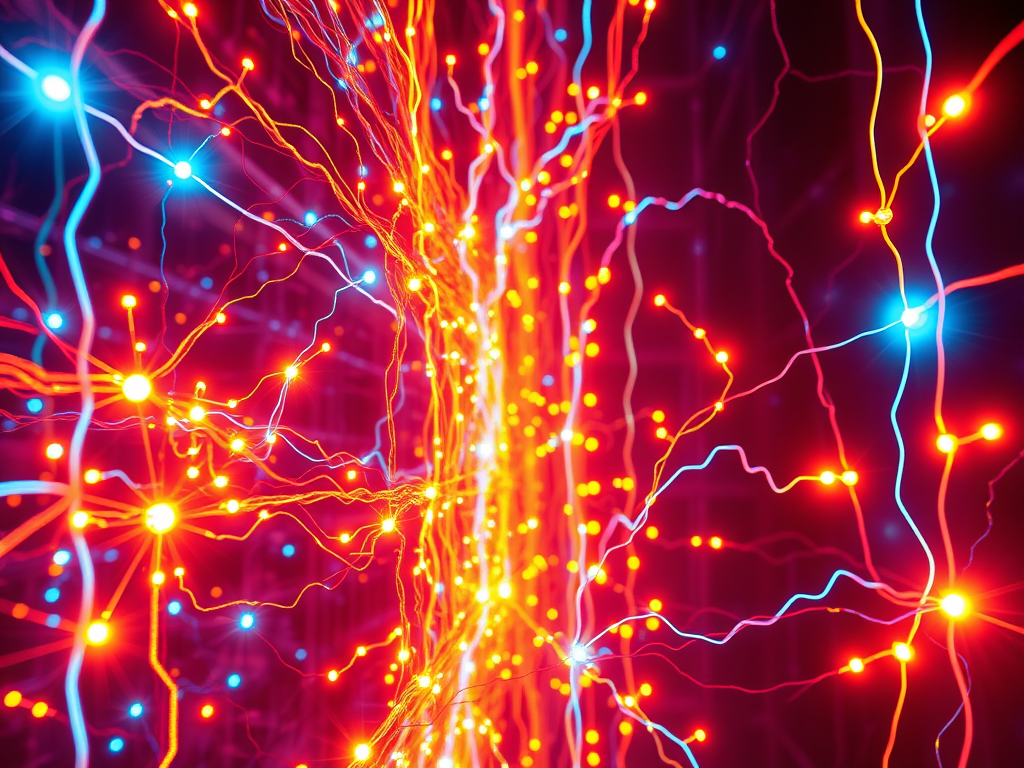
Across the airwaves, in living rooms, cafes, offices, schoolyards throughout the land, tiny networks of sparking ADHD intuition are leaping synaptically from one brain to another, sending out tendrils of communication, recognition and energy.
If the power of such a network could be harnessed, we would be the equivalent of a global wind farm.
The neurodiverse have a reputation for:
– being able to read a room – and practically smelling an argument growing before it’s even a seedling…
– sensing danger before it arrives
– empathising way beyond the normal call of duty with other people…
I mean, we also often have raging paranoia, RSD, and inferiority complexes of course, which does complicate matters somewhat, but that is beside the point here. (and for a reminder of the brilliant things only, about ADHD brains – see fantastic beasts and where they are hiding)
Why does it feel like ADHD intuition is stronger than average?
ADHD brains are sparky, perceptive and empathetic. We can feel the energy of a room before we even see the people in it, and we have a magnet for threats or danger that could be classable as military technology.
As with many of our differences, our intuition, or perhaps more accurately, how acutely we are tuned into it, I think comes down to our lack of filters in the information our brain is producing and receiving.
Our brains are untethered. They let information in and out more readily, sometimes more deeply.
Differences in the working of our executive function mean that we have less control over this everyday input and output, whether it is from other people, from sensory experiences, or from the weird and wonderful contents of our own thoughts.
We are also more likely to recruit the amygdala (the part of our brain that governs emotions) as a sort of back-up drive when our executive function is struggling.
We can do this throughout our everyday lives and interactions, meaning that the senses and events of everyday may be lent a unique perspective – being seen through a more emotional lens.
I have always seen the executive function area as a kind of sorting, or post-office, at the front of the brain, in the pre-frontal cortex.
In a neurotypical brain, there are ten staff calmly and methodically sorting the incoming and outgoing mail, correctly filing items that might be important, binning those that aren’t. They have the correct number of breaks, and clock off at the required hour, work completed.
In an ADHD brain, the sorting office is chronically understaffed. There are only three employees, but they work at the speed of light, instinctively zooming the relevant correspondence paper aeroplane style to what feels like the best destination at the time.

There are many piles of unopened mail in this office, sheafs of paper piled in the corners, and probably quite a lot of chocolate wrappers.
The lights are a dim yellow, giving off that juddery horror glitch like the bulbs are about to blow, and the staff have a manic and overworked gleam in their eyes.
But somehow, through all the confusion and chaos, in fact, maybe because of the confusion and the chaos, they occasionally spot something urgent from an innocuous looking pile of mail, they accidentally memorise names and addresses from forgotten departments in other corners of the brain, they even see patterns, and beauty, in the stuttering yellow orb of the office light.
ADHD brains can find it difficult to tune into the so called “normal” rhythms of the everyday. We are a walking distraction field, and as we zone with intense interest into and out of the situations around us, we are actually taking in not just the situation, but everything on its periphery – all the invisible threads and feelings running through it, and a sense of its significance, in that moment, and in space and time itself.
Sound a bit dramatic? ye-ees, but what I am talking about here is the reach our brains are capable of in any given moment.
They go a-wandering, they go a-leaping, they see something deep within and from a world away at the same time.
We are walking paradox generators, and our untethered openness to anything and everything means that even as we are tuning out… we are tuning in.
Our first demonstration of the ADHD intuition field in action is….
Neurodiverse magnetism…
There is a reason that comedian Sara Pascoe described ADHD as like a pyramid selling scheme.
For the late diagnosed in particular, as we unveil our true selves, start to really see and understand how our brains work, we start to recognise our fellows with the ease of selecting a leopard from a line-up of pumas.
They jump out at us…and we just know.
And as they start to jump out at us from the mysterious primordial soup that society has become, a new truth is revealed.
We have been subconsciously surrounding ourselves with them for years.
I discussed this with my partner recently, when I said that I wasn’t actually sure I knew anyone neurotypical, having recognised more and more neurodiversity amongst friends, colleagues, acquaintances etc… and that according to my calculations it suddenly felt that around 50 per cent of the population must actually be neurodiverse.
He agreed with the former, but not the latter part of the observation, which lead us both back to the force of neurodiverse magnetism.
We now know beyond doubt that neurodiversity runs in families, which makes recognition of neurodiverse traits much harder – as we have lived in and amongst them as normal for years. (See – How to spot neurotypicals in the wild – for a tongue in cheek guide to this taxing subject)
But beyond direct family bloodlines, how many of us have discovered that our partners are also neurodivergent? our best friends? Those one or two people that are the only ones you’ve ever felt really comfortable hanging out with at work?
There is an electric intuition, and perhaps an inbuilt survival mechanism at work here, where we seem to have unintentionally surrounded ourselves with our kin.
Does this stem perhaps from a deep-seated desire for connection? maybe even for self-preservation in a neurotypical world?
From feeling an outcast continually at school, except for maybe one unique friend if we are lucky, to being drawn to the quiet, awkward, or crazy ones that we work with, subconsciously, we pull in connections we feel we might trust…
…other square pegs in round holes.
And maybe not just because their brains might work more like ours, but also because their sense of displacement, rejection or otherness – and consequently altered life experience – might mirror our own. Like we are actually existing on the same plane – fellow wanderers in the wild…

I’m not sure there isn’t a genuinely primal, almost pheromonally driven initiative to this behaviour, as the pattern seems to arise throughout the neurodiverse community.
Which brings us to pattern recognition, which I believe, in ADHD, AuDHD and autistic brains, is happening on a subconscious level all the time.
Again, those more open mental boundaries, the wider reach, the bigger picture, means our brains are making connections that might elude others, and these connections are sometimes fuelled by our senses alone…
ADHD Alert mode – hypervigilance, danger drive – fight mode…
ADHD brains are fuelled on gut instinct – a mental, emotional, physical connection to what is going on which overrides logic…We can feel when something isn’t right…
Gut instinct, intuition, is of course not a sole property of the neurodiverse.
Most people have experienced these senses in certain situations of life, have met people we instinctively don’t like for instance, or wanted to leave a place because we didn’t like the atmosphere.
In a lot of everyday situations however, where I think the difference lies, is in…
The neurotypical logic overlay…
In modern society, and as adults, there is an expectation that logic is the king or queen of sound judgement.
When deciding on the veracity of information, the reliability of a person, the safety of a situation, the overriding expectation is that we must apply a litany of facts, which, once supplied, can be balanced, measured, cogitated upon and therefore judged appropriately before reaching a conclusion.
Well I’ve got news for you, logic brains…life doesn’t always work like that.
Society has evolved, if you wish to see it that way, to place logic before instinct.
Logic, intellectual discussion, objective analysis are all of course extremely important facets of our capability as intelligent beings.
Over time however, these advanced qualities of the human brain have lent the idea of “instinct” “gut feeling” and intuition a secondary, eccentric, if you like “witchy” air.
People’s instincts are often viewed as at best complimentary to their logical analysis, and at worst, peculiar emotional hiccups or indulgences that interfere with the progress of an issue.
In actual fact, I would argue that sometimes trying too hard to apply logical analysis has the capacity to confuse an issue, if instinct has already kicked in, and our obsession with intellectualising can actually cloud and confuse our guts inner voice.
For an ADHD brain, which can spend hours analysing, over-analysing, and assessing consequent myriad manifestations of actions or decisions, we are on a sure route here to procrastination, overwhelm, and paralysis.
I believe that due to our looser filters, our wider scope of available sight, senses and information, neurodiverse people have a constantly raised awareness of senses and situations that may be too far on the periphery for others to notice.
This information will often arrive suddenly, in a disorderly manner, and quite frequently, can be an interruption, and inconvenience.
It is also, I believe, part of the origin of that old neurodiverse favourite, hypervigilance – which, while obviously a blessing in say, mid- zombie apocalypse, is not always welcome when for instance, simply standing in a queue for a coffee, hearing a cup smash on the floor and jumping approximately two feet in the air primed in a ninja attack stance.

Our hypervigilance, our high access gut- brain communication loops, can lead us to feel stressed often, to feel overly alert. But they can also genuinely alert us, and they shouldn’t be dismissed.
Gut instinct, when we allow ourselves to tune in, senses danger, it senses connections – it senses when something isn’t right.
Let me tell you are brief but powerful tale of gut instinct.
A few years ago, we were interviewing for a position at my place of work. Several of the candidates were abysmal, one seemed quite steady and reliable, and one appeared to stand head and shoulders above the rest.
The man in question had experience and qualifications that far outshone his competitors, he had presented himself smartly and suitably for an interview, and he was extremely articulate.
He was quite obviously the best candidate for the job. On paper.
When the interviews had concluded, myself and my boss at the time stood in our little office and agreed, peculiarly half-heartedly, that he was the best candidate for the job.
” I suppose I better ring him and offer it to him then” I said. And we both just kind of sat there. And then I said “Weird, I don’t seem to want to pick up the phone.”
I went on to say that something didn’t feel quite right, and my boss could clearly feel it too. “Google search him” he declared, following our mutual gut instincts.
Following the obvious details of name and address only that were available to us, a shockingly short amount of digging lead to an appalling revelation.
Firstly, the man had been in prison, and this had not been disclosed, secondly, there were historic news articles from his neighbourhood about his behaviour, which related, sadly and shockingly, to crimes and public displays of misogyny and violence.
He was a small, smartly dressed, older man, and this kind of character wouldn’t have been easily deduced from meeting him. Not that there is any particular way you can expect a type of person to look, but the only clue, or physical indicator, when we looked back, had been that despite me leading the interview, the man had addressed his answers primarily to my boss, which was not really the most appropriate or polite conduct.
Now, I’m sure there is an argument that could be levelled here, that actually a series of logical clues led us to this feeling.
So maybe, and I’m going to be a paradox brain for a minute again here, maybe, part of gut instinct is the brain silently spotting and assembling logical clues and forming them into patterns that lead to an overall sense….good or bad…right or wrong.
And maybe that is part of how it works, but the fact remains, if we had use the expected logic overlay, weighed up the facts, the qualifications, the interview as a whole, we would have employed a potentially deeply unpleasant character who could have posed an actual risk to safety.
Following the revelation my boss said “I’ll have to listen to you – you’re a witch”
Now, not everyone would take that as a compliment, but I’m reasonably sure it wasn’t meant as an insult, and given the circumstances was more a positive reflection of the very real power of my intuition, and indeed the wisdom of listening to your intuition in general.
I have spent a lot of my life, in common with many other neurodivergents, pushing down feelings of discomfort due to my highly tuned senses, attempting to apply a logic overlay to things that didn’t feel right.
It isn’t always possible, and neurodivergent discomfort is frequently brought about by our high level of sensitivity in itself. Within that high level sensitivity though, is a higher tuned awareness of instinct, of right and wrong, of danger.
Following those events, when a sense is as strong as that, I have never questioned it again.
Trust your gut. It knows stuff you don’t.
The reach of ADHD intuition is as vast as the reach of our thoughts, but the last area of influence I want to mention today is… Empathy.
ADHD empathy is different….
ADHD intuition leads us to different understanding and empathy with others…
Our understanding of the lives and emotions of others, is, like everything else in the neurodiversiverse, non-linear. Often, apparently non-sensical.
I have mentioned that our attention phases in and out intensely, and unfortunately, this can be a difficult one in dealing with people.
We are all aware by now of the difficulties of an ADHD brain in communication, and consequently in managing friendships (see don’t keep me hanging on the telephone…. about exactly that)
And we are aware that object permanence, as well as fractured attention spans, can cause problems in providing meaningful friendships to others.
But you know what? You will struggle to find someone with more genuine bone-deep upset if someone is hurting. You will struggle to find someone more ignited into action by injustice or unfairness.
When an ADHD’er takes your side, fights your corner, woe betide the opponent.
We are a force to be reckoned with.
You see, if someone has a problem, we are not reacting merely to their words of explanation (in fact it is highly likely we won’t have processed them all correctly) we are responding directly to their senses and their feelings.
We feel them in the airwaves, and sometimes, we know, without words, what is needed.
Be aware that this is far from a fail-safe with us in dealing with other people’s emotions – as we don’t always get it right.
Our intuition radars are as easily distracted as we are, and our emotional antennae can be subject to damage by inclement weather.
BUT…
On occasions where they are working accurately, and where we actually allow ourselves to follow our instincts, we can suddenly and surprisingly emerge to support others as:
– the voice of calm
– the voice of reason
– the voice of inappropriate but welcome humour
– the voice of the flustered looking stranger at the bus stop who makes sudden awkward conversation with you because she was worried that you looked lonely or sad that day
– the voice of the only one with the balls to offer a hug to a crying stranger
-the voice of the person who really laughs with you, like they’ve known you all your life, when you have a meltdown in a supermarket queue, and seems to offer you a warm connection, for just a moment, making you feel a little better…
– the voice of the person who spends several hours trying to help you fix something even though they’ve only just met you…
ADHD intuition causes waves of empathy and connection to flow through us, if we’re lucky, to listen to and help friends, to make family members laugh when they need something to make them smile, to connect with and uplift strangers who we didn’t even know were struggling…
Sometimes, we are far away, unreachable, due to the peculiar machinations of our volatile brains, but at other times, we are 100 per cent with you in that moment, friend or stranger, and our crazy energy, our genuine will to make people happy, is all yours.

ADHD intuition can be a pain in the arse…but it’s also a force to be reckoned with, and celebrated…
This isn’t a force we have much control over, much like our emotions, or the flow of our ideas, all of which of course, are also tied in to the mighty intuition.
But what we do have control over, is respecting it, and listening to it….
Accept that ideas and senses don’t have to be orderly, linear, or logical, to have meaning and significance.
When you examine life closely, some of the best, or most exciting experiences or decisions have probably been instinctive.
Throughout our chaos, our level of connection to our intuition helps us to seek inspiration, to help others when we feel help is needed, to sense dangers or actions that are invisible to most naked brains, and to dive deeper and more curiously into the wonders and intricacies of life.
Our wide open hearts and ninja senses might make us more fragile, but when we wield them fearlessly, we let much needed beams of light, perception, and silliness through to the rest of the world.
 bewilderbrain
Thoughts or ramblings welcome here…