
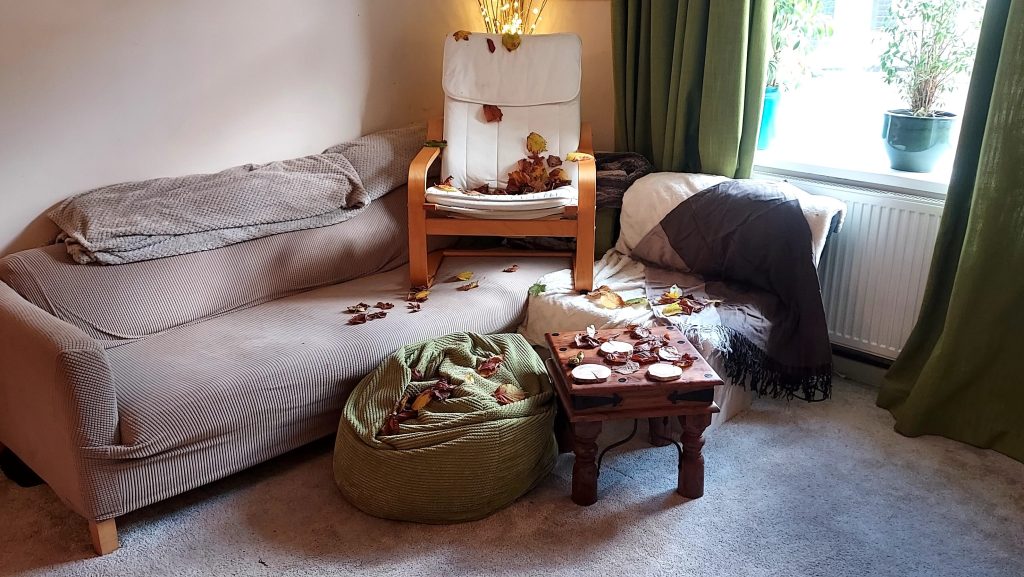
Spontaneous DIY, re-invention of the house, and a burning need to change things…
When that urge has taken hold…move as quickly and calmly as possible out of the path of the ADHD’er with a hammer…
I used to think everybody did it. And before I was aware of my ADHD brain, I used to joke apologetically to my long suffering partner that it felt like some kind of sickness….
The anxiety, the compulsion…the inspiration, the itch…. the absolute NEED…to change the room around.
As the children return to school, the rain falls outside, and the first whispers of the real autumn hint of crunchy leaves and toffee apples…
I realise that season change is a definite catalyst for another bout of furniture sickness.

ADHD’ers have a peculiar relationship with their homes, with space… and with stuff
You could call our relationships with our homes a love/hate one. Though I think this might be a bit simplistic.
People with ADHD and other forms of neurodivergence can struggle with organisation, tidying, and well…. knowing where stuff is.
Unfortunately, our brains are almost uniquely programmed to find states of disorganisation, clutter and general chaos stressful.
This makes life difficult, to say the least.
For many of us, we actually feel a bone-deep need to be in a clear, calming and organised environment, and our inability to manifest this causes a very real, and often constant level of anxiety and stress.
So we keep trying.
But rather than a constant process of putting things away properly and cleaning on a schedule, the ADHD brain chooses a different path…
For one thing, this former approach is rather too dull to get a handle on, and secondly, we don’t really believe small every day routine changes will actually have the capacity to make a difference.
No, no something far more radical must be needed.
We need to fix our home. It can fix our lives. We need to do it now...
If our immediate others are lucky, the project to fix our homes will be as simple as a small room re-orientation. If they are less fortunate, we may decide it is necessary to knock down a wall, build an extension, or purchase all the storage solutions Ikea has to offer.
And the thing is, once we have the bit between our teeth, we genuinely, from the heart, feel that our project will have the power to transform our lives and our home for everyone.
That season change feeling has been building in me for the last couple of weeks. The excitement, the movement, the sense of something indefinable, bigger, beyond our reach, shifting its mystical bottom.
I love the sense of the in-between it brings, the motion and the change, but there is no question that the magical machinations of mother nature are a trigger for me.
The thrill of the seasons changing shifts the balance in my fragile but powerful senses…
It’s like the seismic motion of nature and the seasons invokes in me an insatiable need to follow its transformative pathway.
The earth moves on its axis and therefore the sofa must follow, in a slow-motion revolution to the dark side of the room…
In our 12 years of residence in our modest terraced home, rooms have moved around, projects have seeded, bloomed and withered more times than I can count. Furniture has been bought, and subsequently sold again.
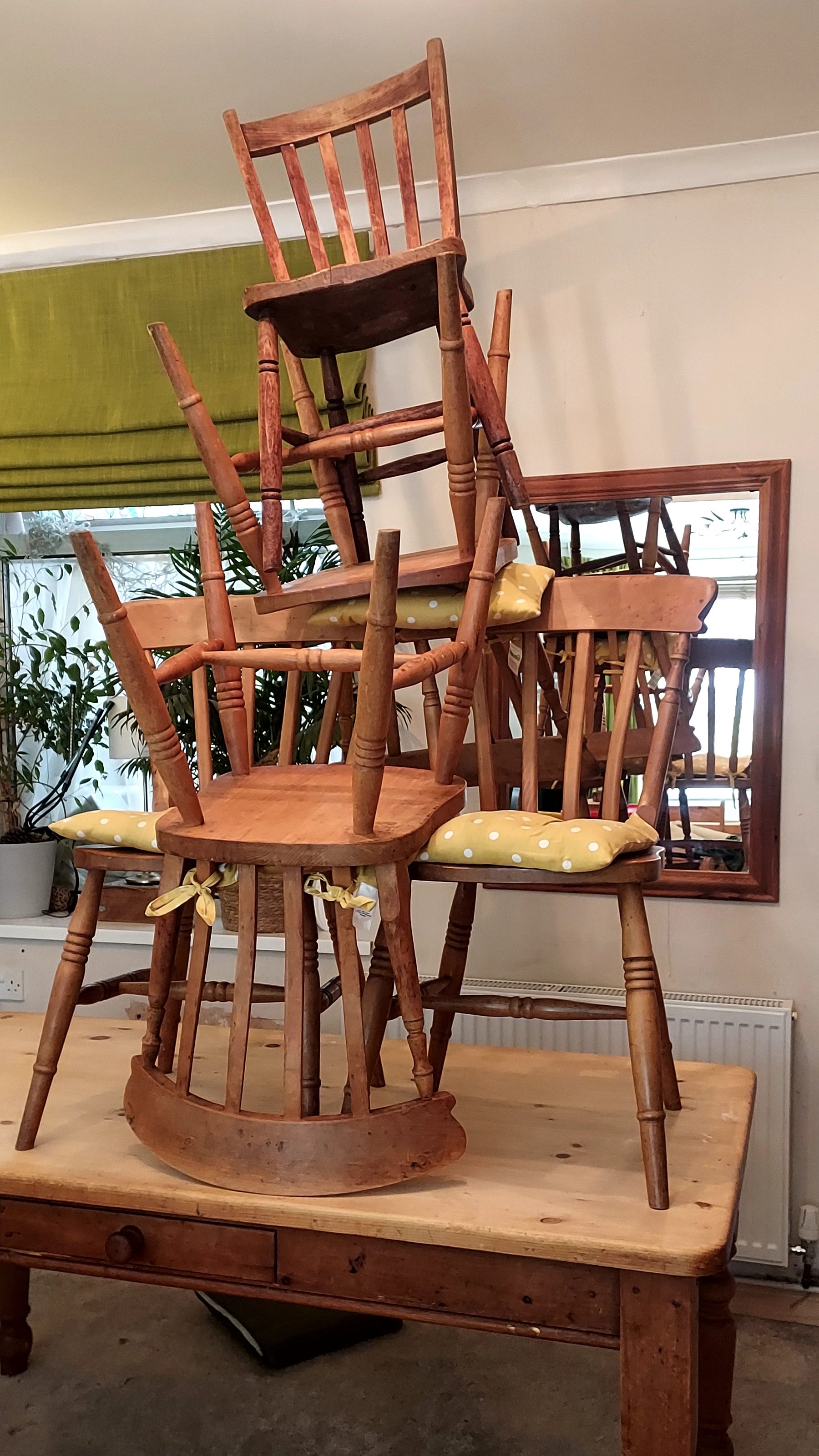
I am frequently discovered at some inexplicable mid point of an enormous project, with chairs appearing suddenly stacked on top of the table like that scene from Poltergeist.
On one occasion my partner was sent to Nottingham simply to acquire a well priced and otherwise unavailable corner section for a now discontinued and elderly Ikea sofa.
On another occasion, I decided to remove the Nottingham corner sofa segment so that I could put two sofas in different positions in the room.
I couldn’t find the feet for one end of a newly liberated sofa, so my partner came home to find a new room layout, with one standard sofa, and my children gleefully propelling themselves down the other, which now sloped diagonally, slide-like, down to the floor.
It starts with unsettled feelings…a need to change something
… and then a little spark.
Just, walking into a room, and receiving one of those electric idea flashes so common to the ADHD brain. As if we have special antennae picking up room layout ideas that are floating on the airwaves.
Once an idea has appeared, our inventive brains will grab the reins and gallop at full throttle to extend its reach, fill in all the details and variables, and generally gild it with gold.
I mean, this all sounds rather fun and charming doesn’t it? Creative ADHD brains and their propensity to re-invent the wheel?
Unfortunately, this compulsion is not all fun and games...
The Dark Side of the Room
Furniture sickness, it seems, can actually become physiological.
This overwhelming desire for change, and the URGE to instigate it, becomes a beating drum inside our head and our bellies.
Once the fuse is lit, not being able to act on my desires feels like a ball of fizzing electric anxiety in my stomach, a low level but constant physical pain.
I experience an intense, uncomfortable restlessness that drives most other thoughts from my head, and my brain gets stuck in a repeating, exhausting loop of imagining, re-imagining and calculating, how I can engineer the changes I feel at this point are crucial, to my wellbeing.
If we are allowed, or able, to start a large or small project in our homes, according to our current electric drive and vision, we can get frustrated, upset, emotional, if things don’t go to plan – causing ourselves and those around us much stress and anxiety.
If other people’s time, money or energy has also been invested in our project, we are likely to feel unable to ask for their help when it hasn’t gone as we wanted it to, or admit that we would rather, actually, put things back the way they were before…
This may result in us having to put up with a home that we are even less comfortable in than we were originally….
It should also be noted that this compulsion to make changes in the home becomes a hyperfocus, and therefore comes with the further associated risk – overstretching and tiring ourselves, mentally and physically…a scenario we are unlikely to notice without help and intervention.
BUT, here’s the thing…
As we are unable to switch off that fizzing, excited ball of anxiety, we are also likely to get frustrated, upset and emotional if we are NOT allowed to carry out our projects and desires.
The whole idea, the NOTION of the change it could bring, becomes inappropriately and completely drenched in emotion… (see also The ADHD Emotion Ocean – why and how neurodivergent feelings are different)
To the casual bystander, this sort of behaviour sounds overall like a massive pain in the arse. And lets be frank, it often is.
But we are talking about a physiological compulsion here, so can we be clement?
Should we be allowed to pursue our sofa moving, idyll creating dreams? Or are we being naughty and bad and causing stress to others and ultimately ourselves?
In part, we need to investigate why this is happening…
What drives the ADHD need to move furniture around and re-invent our homes?
Where does this compulsion spring from?
1. Dopamining – The ADHD brain is on a constant quest to top up its flailing supply of precious dopamine..
ADHD’ers have lower baseline levels of dopamine, one of our crucial feel good neurotransmitters, and our brains and bodies are almost constantly seeking ways to top up our puny reserves.
There are so many ways this can manifest, from things as obvious as food or alcohol intake, to less obvious things, like causing an argument or friction, which bizarrely, though negative, can actually temporarily raise dopamine in the brain, and explains a gamut of ADHD behaviours.
How does moving the furniture around raise dopamine levels?
A. The ADHD brain loves a project…
Moving the furniture or attempting DIY is a project. A project has the capacity to focus the brain, tuning out some of the other noise and unsettled feelings.
But crucially, a project also involves creating something, and the act of creating something boosts dopamine levels in the brain…
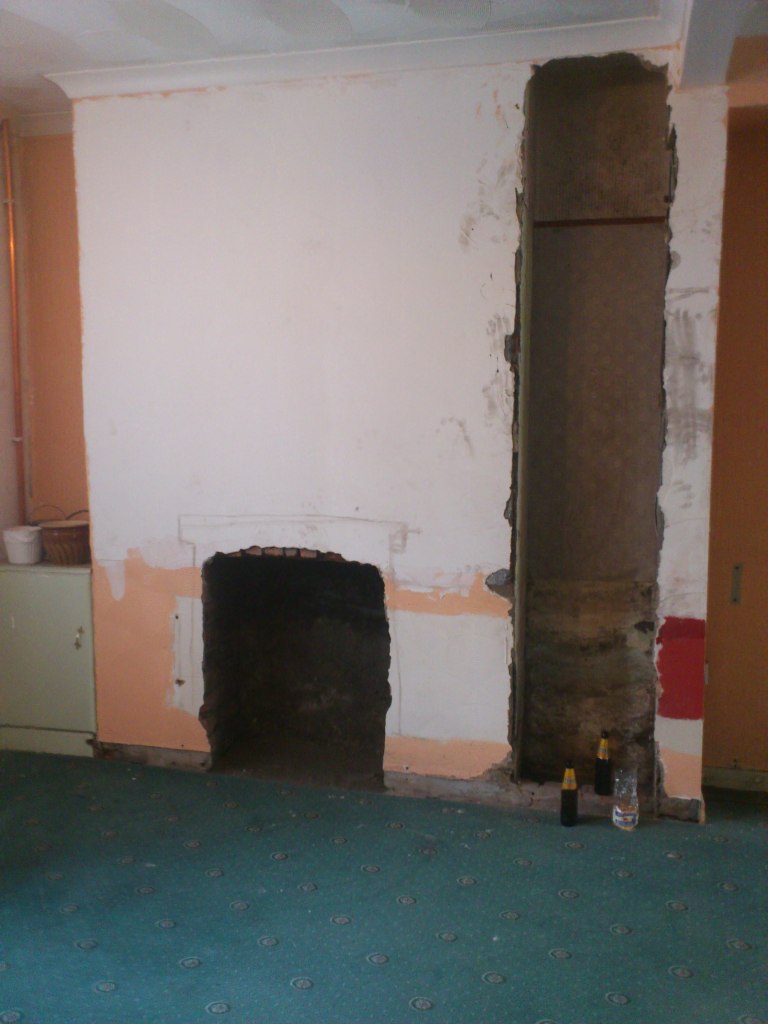
Look! Look! we knocked a load of holes in the wall! we re-created the fireplace! then we found an alcove too!
This is from many years ago now. And yes, that is indeed two beers and half a packet of Welsh cakes, we know how to reward ourselves you know.
B. The ADHD brain is a novelty seeker…
As well as the project itself, the results will be new to you, as yet unknown, and your home will feel different and novel once it is complete. Novelty, and the unexpected, can boost dopamine levels in the brain.
Entering uncharted territory presents a challenge, and challenge further boosts neurotransmitter levels.
C. Neurodiverse brains seek out puzzles…
Whether it’s putting a cupboard together, or the logistics of arranging the furniture so that that cat has a good view of the TV, puzzles are stimulating. In both the challenge these projects offer, and in the satisfaction of pieces clicking correctly into place, puzzles boost dopamine.
D. Curiosity…not killed, but maybe at least winded the ADHD’er…
We are inescapably, hopelessly curious and inquisitive creatures.
What would it look like if I moved that over there? How would the room feel?
Its that wall original, or is it stud? What if we put a stained glass window across the whole front of the house…etc…
Curiosity promotes investigation.
Investigation, and the accompanying resolution, stimulates dopamine.
A couple of autumns ago, we were in a position to treat ourselves to a very badly needed living room carpet.
The evening before its delivery, after hoisting out the old carpet between us, I stood in our freshly shorn and empty living space.
I found my eyes weirdly drawn to the two fireplaces.
“Have you noticed..” I said… that peculiar glint probably appearing in my eye. “That the inside of that fireplace, for some reason, doesn’t seem to go as back as far as this one? Why would that be…?”
Partner extremely cautiously indulges my curiosity…
Commence google search. Resulting discovery that Victorian brick fireplaces often had a thick layer of concrete render filled in over the back.
Ah, that explains it then.
Anyway, better get to bed, we’ve got the carpet fitters coming tomorrow afternoon, and I’ve still got a load of stuff to do. Useful, normal household jobs, you know, as well as sweeping up the floor properly.
I go to bed. But the little blinking light of curiosity in my brain has been activated, and turned up to maximum luminosity.
The render in question in our fireplace is ugly and black….
Might the bricks underneath be pretty and bricky?
The result at this point is a foregone conclusion. My partner returned home from his half day at work to find me sitting in the fireplace, face entirely black, hammer and chisel in hand, and surrounded by a small field of extremely dusty rubble.
I always find that if you are going to knock out the back of a fireplace, the perfect time to do it is a few hours before you are due to have a brand spanking new cream coloured carpet laid.
Instead of being told off, I was actually greeted with a resigned and slightly amused… “I knew you’d do that”
My partner is a hero.
He helped me complete it… and even clear up the dust and rubble, as by this point, I could barely move my arms.
And the fireplace? Well, I wouldn’t go so far as to say pretty, perhaps, the century old bricks underneath did turn out to be a touch on the crumbly side in places. But they are not horrible black render, and they are indeed, without question, bricky. So all was well.

2. ADHD and neurodiverse brains have an exaggerated need for control…
This is a massive one, and it again affects so many areas of our lives.
I have always looked at it like this…
In a world where a lot of what is going on on the outside feels inexplicable, inaccessible, or borderline frightening, and where the world inside our heads is a chaos festival of chimpanzees with an anger management problem…
…controlling anything you can takes on a profound, almost religious importance.
ADHD’ers obsess about seemingly small details and decisions precisely because we do actually have the power to influence some of these things…
And so much of what our brain does feels beyond our control.
If we can create, organise and curate our external environment to the point of oblivion, surely we will finally gain mastery of ourselves?
We are trying to shut down some of our brains many uncertainties by creating our own specific reality.
We look at our home environment, and making changes to it, as our opportunity to exercise autonomy. Imposing law and order onto our turbulent worlds.
I have said that season change appears to be a catalyst for me, for this urge to change, to impose control.
Maybe then, these fierce and all consuming desires to make changes in our homes are actually a psychological reaction to feeling out of of control in other areas of our life.
Do we experience this feeling more if there is instability in our workplace? Our family? When our general stress levels are high?
over- indulging our compulsions, even with the best intentions, can be risky…
Continually making compulsive changes to your home can be counter-productive.
As well as tiring ourselves, and potentially causing stresses or disagreements with other inhabitants, we can unsettle the stability of our home atmosphere by altering it too frequently.
Which is disruptive to the neurodiverse brains of both adults and children.
And the problem with using our homes to gain control, is that our need for change will inevitably win out again at some point…
The systems or placements of things we adopt in our homes to manifest this control can in themselves become overwhelming, be hard to stick to, or indeed, impossible to remember.
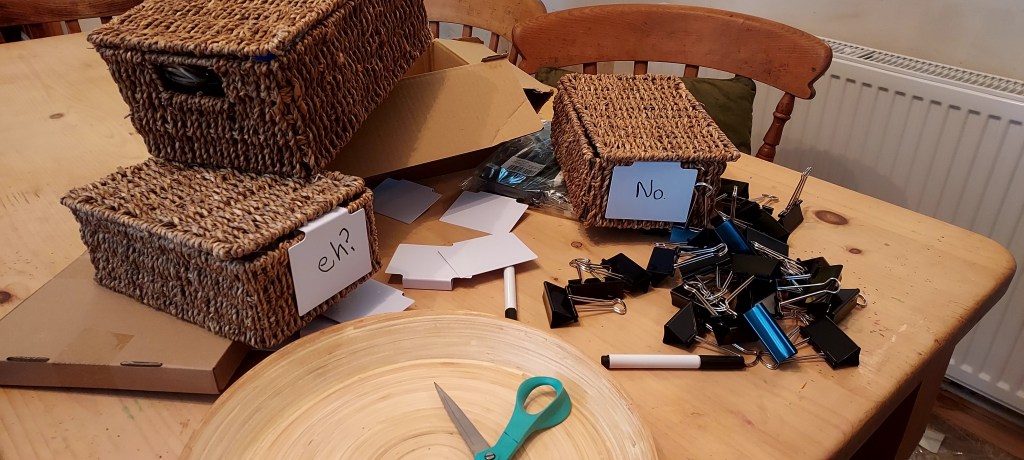
Add in the fact that Project completion – can be another variable and stressor.
We can often produce incredible bouts of energy to complete big, exciting tasks, or move huge pieces of furniture to new locations…but by the time it comes to dealing with the resulting fields of smaller debris, our dopamine has run out, our motivation has dwindled, and the classic, but sadly unhelpful ADHD tidying methods of Hidying Up, and Moovering, will end up being employed…
We then end up with small piles of items waited to be sorted around the house for long periods of time, or better yet inserted into plastic bags and dispatched to the cupboard of doom…
To re-iterate though, we are trying to use the control of our home environment to fix a problem.
Because we don’t know what else to do.
Because we feel helpless.
But we are desperate to fix something.
And this feels achievable. Solid, maneoverable objects, that won’t answer back or have complicated rules that we don’t understand. Whatever else is going on in life, this our space…our rules.
Which brings us to…
3. The primal neurodiverse need for protection, security, safety…
Yes. Everyone desires protection and security on some primal level.
But in a bewildering world, with a sometimes bewildering, if also brilliant brain, this need is amplified tenfold.
If you need reminding of all the brilliantly wonderful things about ADHD brains, see Fantastic Beasts and where they are hiding – 5 reasons to seek out and celebrate ADHD brains
ADHD’ers and the neurodiverse in general spend much of our time feeling that we are balancing precipitously on a parapet.(try saying that with a mouthful of crisps)
Life with a neurodiverse brain can feel like there are wrong turns, false throughways, concealed (and sometimes congealed) exits, unspoken, inexplicable rules, and a mind boggling array of sources of irritation and overstimulation out there in the world.
As well as in here, in our brains.
On a deep subconsicous level, we want to create spaces that are capable of healing and nurturing us, away from the noise and confusion.
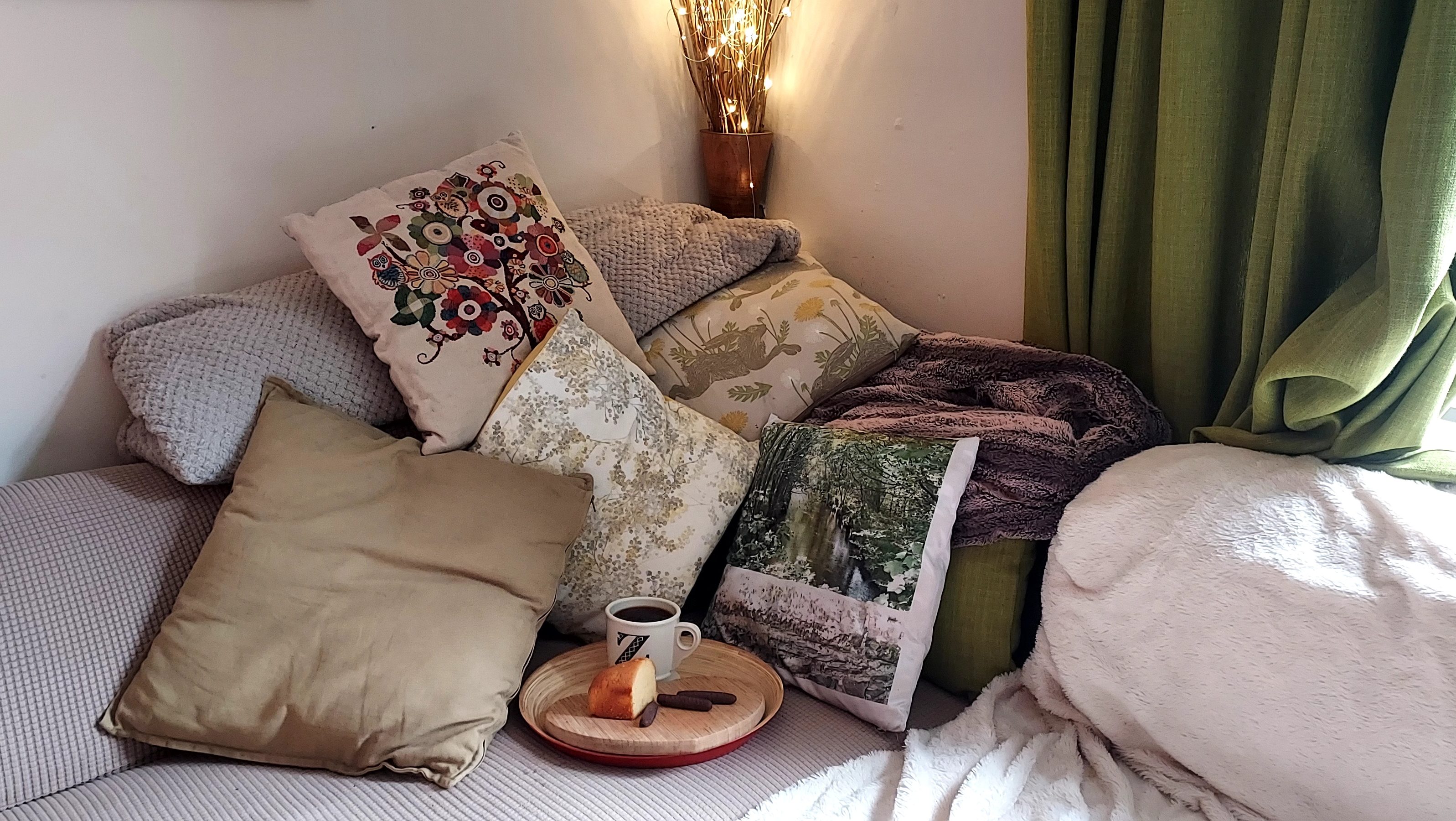
If we are parents, we also put a lot of time, energy and worry into creating spaces that are right for our children – that offer safety, reliability – maybe even magic, and escape from the world.
So does the wild volatility of our instincts mean have to suppress our ADHD furniture moving dreams?
I am going to say… No. With some caveats.
Let me make my case.
Our change and project compulsions appear from unsettled brains, that may be needing a hit of dopamine, that may be needing a focus or distraction, that may be striving really hard, to seize control of their chaotic environments.
Are these urges always successful? No.
But the thing is, sometimes we have incredible ideas.
ADHD brains tend to be very visual, visionary even, lending us particularly to aspects of creativity and design. And the synaptic leaping style of our thoughts and ideas actually has an astounding capacity to come up with innovative solutions to problems.
And we are only EVER, driven by a desire to make life better or easier for everyone…
Allowing us some freedom, within reason, to express our creative desires, our boundary setting, our deep-seated need to nest and cocoon ourselves, can actually do us good.
It can offer a re-set, a comfort…. an uplift, to a struggling brain.
We are not always going to get things right. But if this urge has arisen, the chances of stemming the overwhelming tide for any significant period of time, to be frank, are slim to none anyway.
Respect the importance of this desire to us, it’s origin, and whether it could actually be helpful. Work with us, rather than against us, to moderate our craziest or most unrealistic whims. And try not to be cross.
Understand that this is a NEED, that can be very hard for us not to fulfil.
Similarly, we have to recognise to try to moderate our ideas where we can, to compromise with others in the household, to try not to cause too much disruption. We need to be honest about how unsettled we feel, how strongly we want to change something, and why.
Whenever we can, we have to talk it through first without bulldozing other peoples sofas.
I believe the most important of the drivers for our furniture changing compulsion, is the overwhelming desire for safety and security.
Things outside, other people, the too fast and too slow manifestations of the world, the uncertainty, the energy, the awesome power of nature as the skies darken and the seasons begin to turn…
We are swept along in their currents…
Because of this, we have a deep craving for sanctuary.
For some Elysian escape cocoon to seal out the world, blanket our senses, and calm our untameable brains.
and this, I believe, is ultimately why we move things, nest, change, build, create, strive for perfection.
However hard we might find their day to day mastery, our homes are our safe, known spaces.
In here, it’s our time.
When you look at it this way, perhaps our need to move the furniture around can be forgiven after all?

What do you think? Do you have furniture, DIY, or project related compulsions? Any ridiculous renovation adventures? let me know in the comments. Happy bewildering…
 bewilderbrain
Thoughts or ramblings welcome here…